



















































Bandhani’s colours and patterns are often symbolic.
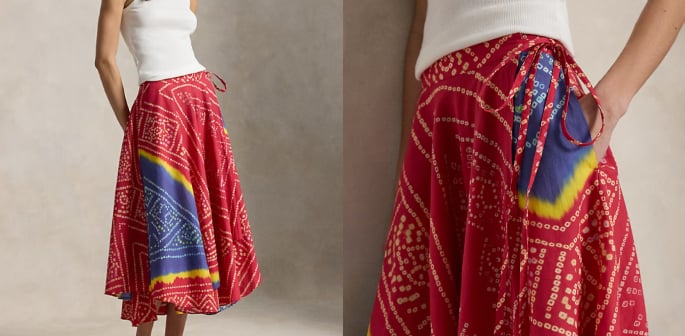
Ralph Lauren is facing fresh criticism after listing a £420 wrap skirt described as inspired by traditional Bandhani tie-dye techniques.
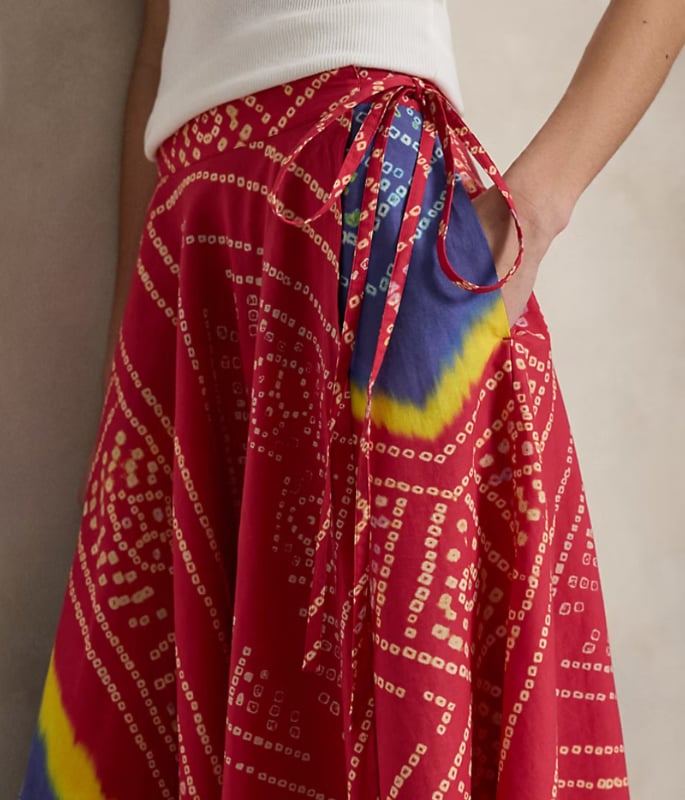
The item, part of the Polo line, is labelled a “Print Cotton Wrap Skirt” in a “Tie Dye Multi” colourway.
According to the brand’s description, the skirt features a wrap silhouette, a tied waist, and an angled cascading hem.
However, backlash has quickly grown online, with critics questioning whether the design appropriately credits its cultural origins.
Many social media users have argued the garment borrows heavily from Bandhani without explicitly naming its Indian heritage.
 Bandhani is one of India’s oldest and most recognisable textile traditions, especially associated with Gujarat and Rajasthan.
It is a tie-dye craft made by binding tiny sections of cloth before dyeing, creating dotted, geometric, and floral patterns with strong cultural meaning.
The origins of Bandhani are often traced back thousands of years, with links to the Indus Valley Civilisation and early depictions seen in Ajanta Cave paintings.
Despite evolving across regions, the craft has retained its core technique and continues to be practised by artisan communities today.
Bandhani is deeply tied to life-cycle events, particularly weddings and festivals across India.
 In many communities, Bandhani sarees, odhnis, dupattas, and turbans are worn for auspicious occasions, symbolising celebration and tradition.
Red Bandhani is especially associated with brides, representing good fortune and prosperity within South Asian cultural practices.
The craft also reflects a strong regional identity, particularly in western India, where artisan communities have preserved it across generations.
 Some reports highlight the role of the Khatri community in maintaining and refining the technique, reinforcing its cultural and historical importance.
Bandhani’s colours and patterns are often symbolic, with red linked to marriage, yellow to joy, and green to fertility and prosperity.
For many, this layered meaning makes Bandhani more than a design, positioning it as a marker of heritage and identity.
Critics have pointed out that while Ralph Lauren references “traditional techniques,” the description stops short of directly acknowledging India as the source.
This has led to accusations of cultural appropriation rather than respectful inspiration.
This is sacrilege! Why Ralph Lauren, why?!
Ralph Lauren, you have no shame! all of the western fashion houses have no shame! You all just rip off Indian fashion designs and rename it with cheap fake material with outrageous prices of $375! pic.twitter.com/Q88iIyCHfw
— JIX5A (@JIX5A) April 18, 2026
Some users have also questioned the authenticity of the design, claiming the skirt appears printed rather than hand-tie-dyed.
Comments circulating online include frustration over what is perceived as a diluted version of a traditional craft being sold at a luxury price.
The skirt retails for approximately £420, or Rs 44,800, which has further intensified the backlash.
Comparisons have emerged highlighting that authentic, handcrafted Bandhani garments in India can cost significantly less, sometimes under Rs 5,000.
This pricing contrast has sparked debate about the commercialisation of traditional crafts without benefiting the original artisan communities.
The controversy also follows recent criticism directed at Ralph Lauren during Paris Fashion Week.
At the time, accessories resembling traditional Indian jhumka earrings were reportedly showcased without clear cultural attribution.
Together, these incidents have led some observers to question whether the brand has a recurring issue with acknowledging South Asian influences.
Bandhani remains important today because it connects fashion to cultural memory, artisan skill, and identity across generations.
That is why modern interpretations can spark debate when people feel the craft is being borrowed without sufficient credit to its Indian origins.
The debate ultimately centres on whether describing a design as “inspired by” is sufficient when referencing culturally significant craftsmanship.
For many, the issue is not inspiration itself, but the absence of clear credit and meaningful representation of the culture behind the design.










 Loading ...